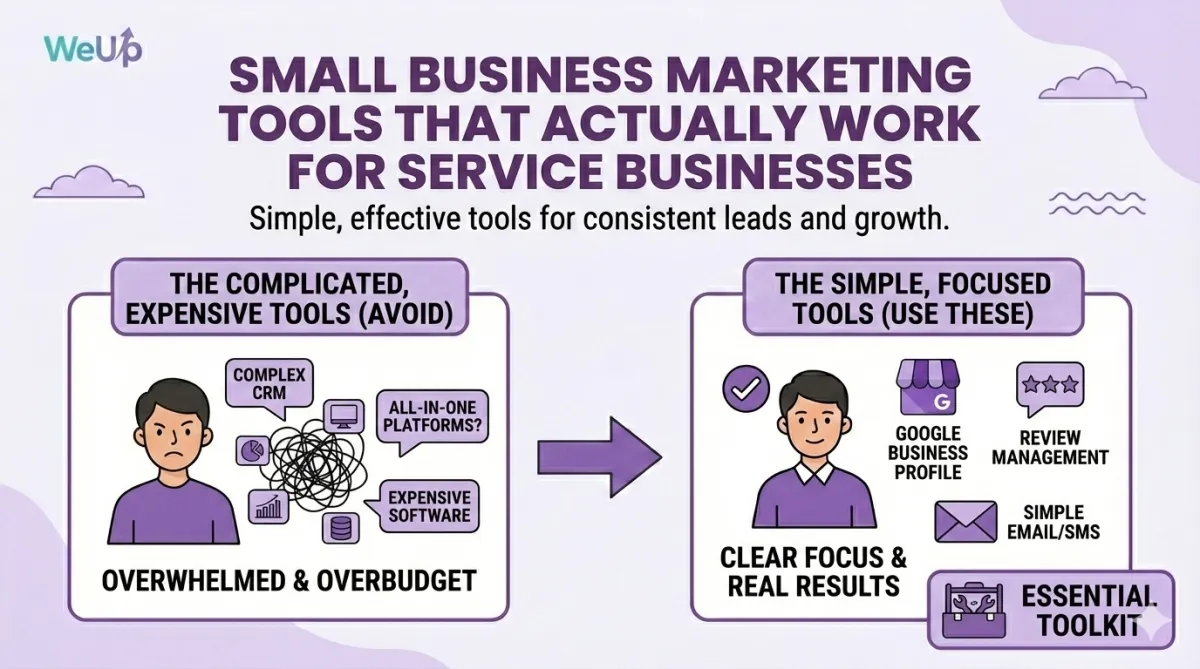
Small business marketing tools for service businesses
Most small business marketing tools are sold as shortcuts. Download this. Subscribe to that. Turn it on and watch leads roll in. That sounds great, but it is not how real service businesses grow.
In practice, tools do not fix broken systems. They only amplify what is already there. If your follow up is slow, ads just send more people into a black hole. If you are not asking for reviews, more leads will not help your visibility. This is why so many cleaning and home service businesses feel stuck even after “trying everything.”
The goal of small business marketing tools is simple. Help you get found, help you respond fast, and help you book real jobs without living on your phone.
For service businesses, the tools that matter most are the ones tied directly to action. Ads that generate local leads. Messaging that responds instantly. Review tools that build trust. Automation that keeps working even when you are on a job.
When these pieces work together, marketing gets easier instead of louder. Leads get cheaper. Booking rates go up. And growth stops feeling random.
This guide breaks down which small business marketing tools actually move the needle for cleaning and home service businesses, why most tools fail without a system, and how to keep things simple without overpaying.
What small business marketing tools really are
Small business marketing tools are not magic. They are support tools. Their job is to help you do a few things better and faster, not to run your business for you.
At their core, marketing tools help with four things. Getting found by local customers. Responding quickly when someone reaches out. Following up so leads do not go cold. Building trust through reviews and consistency.
Most service businesses do not need dozens of tools. They need a small set that work together. When tools are simple and connected, it becomes easier to book jobs, stay organized, and see what is actually working.
The right marketing tools should feel boring in a good way. They run in the background. They save time. They make results more predictable.
Why most tools fail without a real system
Most tools fail because they are used to cover problems instead of fixing them. When leads slow down, owners buy more ads. When phones do not ring, they switch platforms. None of that works if the system underneath is broken.
Without a real system, tools create noise. Leads come in but do not get answered fast enough. Follow up stops after the first message. Reviews never get requested. Ads get blamed when the real issue is execution.
A system is what tells each tool what to do and when. Who responds to a lead. How fast that response happens. What message goes out next. When a review request is sent. When ads should be adjusted.
When a system is in place, tools start to work the way they are supposed to. Ads become more effective. Follow up gets easier. Growth becomes something you can repeat instead of something you hope for.
The core marketing tools every cleaning and home service business needs
Most cleaning and home service businesses do not need complex software. They need a small set of tools that cover the full path from first click to booked job. When these tools work together, marketing feels simple and predictable.
Below are the core tools that matter most.
Facebook ads that drive real leads
Facebook ads work best when they are built for speed and simplicity. The goal is not traffic or awareness. The goal is to get a local homeowner to raise their hand and ask for service.
For cleaning and home service businesses, the strongest ads remove friction. Clear offer. Clear service area. Clear next step.
The three click system explained
The three click system keeps things simple. A person sees the ad. They click once to open the form. They submit their info with one or two taps. That is it.
Fewer clicks means less thinking. Less thinking means more leads. When the form connects directly to your follow up system, you can respond immediately and start booking instead of chasing.
Speed to lead tools that book jobs faster
Speed to lead is one of the biggest advantages a small business can have. Most homeowners contact multiple companies at once. The one that responds first usually wins.
Speed to lead tools make sure no message gets missed, even when you are on a job.
Missed call text back and instant replies
Missed call text back sends an automatic message the moment a call is missed. Instant replies do the same for forms and messages. The customer knows you are real and paying attention.
This alone can double booking rates without spending more on ads.
Simple follow up and messaging tools
Most leads do not book on the first message. They need reminders, answers, and quick follow up. Doing this manually is exhausting and inconsistent.
Text and email in one place
When text and email live in one inbox, follow up becomes easier. You can see the full conversation, respond faster, and keep things organized without jumping between apps.
Simple follow up tools keep leads warm and help turn more inquiries into booked jobs.
Google Business Profile tools that boost visibility
Google is where most local service searches start. Your Google Business Profile is often the first impression a homeowner gets.
Tools that support your profile help you show up more often and look more trustworthy.
Review requests and review responses
Consistent review requests lead to steady growth in reviews. Responding to those reviews shows you are active and professional. Together, this improves visibility and trust.
More reviews also make your ads work better because people feel safer reaching out.
Basic websites and landing pages that convert
A website does not need to be fancy to work. It needs to be clear. Who you help. What you do. How to contact you.
Landing pages tied to ads should focus on one action. Get a quote. Book a call. Send a message.
When websites and landing pages are simple and connected to your follow up tools, they support your ads instead of slowing them down.
Automation tools that save time and protect ROI
Automation is not about replacing people. It is about protecting your time and making sure no opportunity slips through the cracks. For cleaning and home service businesses, automation turns effort into consistency.
When automation is set up correctly, the same work produces better results. Leads get answered. Follow up happens. Reviews get requested. All without extra daily effort.
Lead capture and routing
Lead capture tools make sure every inquiry lands in the right place. Forms, calls, texts, and messages all feed into one system instead of getting scattered.
Routing decides what happens next. Who gets notified. What message goes out. How fast the response happens. This is what prevents leads from being forgotten or delayed.
Good routing keeps your speed to lead high even on busy days.
Automated follow up
Most leads need more than one touch. Automated follow up sends reminders, answers common questions, and keeps your business top of mind.
This does not mean spam. It means helpful, timely messages that continue the conversation when you are unavailable. Automated follow up is often the difference between a lead going cold and a job getting booked.
Review automation
Reviews are easy to forget when you are focused on getting through the day. Review automation solves that.
After a job is completed, review requests are sent automatically. This keeps review growth consistent and removes the awkwardness of remembering to ask.
Over time, review automation improves trust, visibility, and conversion across every part of your marketing.
How to measure if your marketing tools are working
Marketing tools only matter if they produce real results. Likes, clicks, and dashboards do not pay the bills. The goal is simple. Are you getting jobs and are you doing it efficiently.
There are three numbers that tell you almost everything you need to know.
Cost per lead
Cost per lead shows how efficiently your ads and tools are working together. Lower is usually better, but only if the leads are real.
Strong systems often drive lower costs over time because fast responses and good follow up improve performance. This is how some businesses see leads in the range of a few dollars instead of tens of dollars.
Cost per lead should be tracked consistently, not judged after one day.
Booking rate
Booking rate tells you what happens after the lead comes in. If you are getting leads but not bookings, the tool is not the problem. The system is.
Fast replies, clear messaging, and follow up all raise booking rate. Improving this number often increases revenue without increasing ad spend.
Ease of use and return on investment
A tool that looks powerful but never gets used is expensive. Ease of use matters because tools only work when they are used consistently.
Return on investment is the final filter. If a tool saves time, books jobs, or reduces wasted spend, it earns its place. If it adds stress or confusion, it usually does not.
Common mistakes small businesses make with marketing tools
Most marketing problems are not caused by bad tools. They come from how the tools are chosen and used. These mistakes show up over and over again in cleaning and home service businesses.
Buying too many tools
More tools do not mean better results. Every new platform adds logins, notifications, and confusion.
When tools are not connected, leads fall through the cracks. Follow up gets missed. Owners feel busy but nothing improves.
A small, focused tool stack almost always outperforms a large, scattered one.
Quitting too early
Marketing takes time to settle. Ads especially need a few days to learn and stabilize.
Many businesses quit right before results start showing up. They turn ads off after a day or two and assume it does not work. In reality, momentum often starts a few days in once data builds.
Consistency beats constant restarting.
Paying for management instead of systems
Paying someone to post or manage accounts does not fix broken processes. It often hides them.
Without a system, management becomes expensive and fragile. When the manager leaves, results leave too.
Systems last. Tools connected to systems let the business keep running whether someone is watching it every day or not.
When marketing tools work best
Marketing tools work best when they are treated like long term assets, not quick fixes. The businesses that see steady growth are not doing anything fancy. They are doing the basics consistently.
Consistency over hacks
There is always a new trick or shortcut being promoted. Most of them do not last.
Consistency is what compounds results. Running ads regularly. Following up every lead. Asking for reviews after every job. Showing up the same way week after week.
Tools support this consistency. They remove friction and make it easier to keep going even when things get busy.
Patience in the first few days of ads
Ads rarely perform perfectly on day one. The first few days are for learning and adjusting.
Many cleaning and home service businesses see results start to come in around day four or five once ads stabilize and data builds. Turning ads off too early resets that progress.
Patience gives the system time to work.
Who these marketing tools are not for
Marketing tools are meant to create opportunity. That only helps if you actually want more work.
Businesses that do not want more work
If you are already overbooked and do not plan to hire or raise prices, adding marketing tools will just create stress. More leads without capacity lead to missed calls, unhappy customers, and burnout.
These tools work best for businesses that want steady growth and are willing to handle it.
A simple tool stack that works for most cleaners
Most cleaning businesses do better with fewer tools that work together instead of many tools that barely connect. Simplicity keeps things running even on busy days.
All in one systems versus disconnected tools
Disconnected tools create gaps. One tool for ads, another for messages, another for reviews, and nothing talks to each other.
All in one systems reduce those gaps. Leads flow into one place. Follow up is automatic. Reviews get requested without reminders. This makes execution easier and results more consistent.
What WeUp covers and what it does not
WeUp focuses on the marketing side of the business. Lead capture, fast responses, follow up, reviews, and beginner friendly ads.
It is not designed to manage staff schedules, payroll, or internal operations. Many cleaning companies still use other tools for those needs.
Knowing what a system does and does not do helps set realistic expectations and prevents frustration.