Small Business Marketing for Dummies
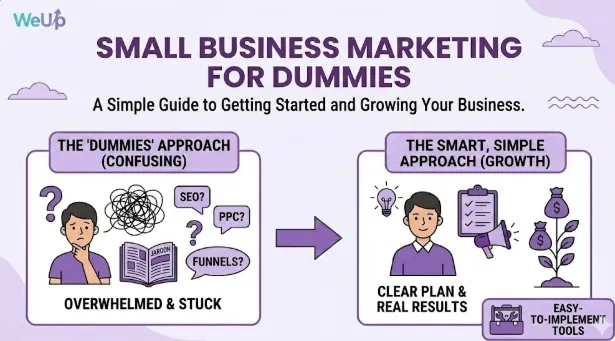
Small business marketing for dummies is not about tricks, trends, or being everywhere online.
If you run a local service business and want more consistent work, marketing really comes down to a few simple things. You need local people to find you, trust you, and contact you.
Most guides overcomplicate this. They talk about algorithms, funnels, and growth hacks. None of that matters if the basics are missing.
This guide is written for real small business owners. Solo operators and small teams who just want steady jobs, not marketing buzzwords.
By the end of this, you will understand:
What actually matters in small business marketing
Why posting and boosting usually fails
What to focus on first to get consistent leads
How simple systems outperform random effort
What Small Business Marketing for Dummies Actually Means
Small business marketing for dummies really just means doing the basics well before trying anything advanced. It is about being visible in the few places your local customers already look.
For most small home service businesses, that comes down to three things:
Being easy to find locally
Looking trustworthy at a glance
Making it simple to contact you
If any one of those is missing, marketing will feel like it is not working.
1. Being Easy to Find Locally
You only need to market to people who live near you.
That means your marketing should be tied to:
Your city
Your neighborhoods
Your service area
If your post, ad, or message is being shown to people across the country, it is wasted effort. Local businesses win by being local, not loud.
2. Looking Trustworthy at a Glance
When someone finds you, they decide fast.
They look for:
Reviews
Photos of real work
A real business name
Clear services
They are not reading long paragraphs. They are scanning.
If you do great work but have no reviews, your marketing will struggle no matter how much you post.
3. Making It Simple to Contact You
Most leads are lost here.
If someone has to:
Hunt for your phone number
Wait hours for a reply
Fill out a long form
They move on.
Good marketing makes it easy to reach you and fast to get a response.
Why Most Small Businesses Struggle With Marketing
Most small businesses do not have a lead problem.
They have a consistency problem.
They get a few jobs from referrals.
Then it slows down.
Then they panic and try something new.
Here is what usually causes that cycle.
1. No One Is Actively Asking for Reviews
Reviews are not optional. They are the base.
Most owners say, “people will leave one if they want to.”
They will not.
If you are not asking every happy customer for a review, your marketing has a ceiling. People trust businesses that look proven, not businesses that say they do good work.
2. All Effort Goes Into Getting New Leads
Many businesses ignore people who already know them.
Past clients are easier to book than new ones.
They already trust you.
They already know your work.
If you are not following up with past clients, you are leaving money on the table and overworking your marketing.
3. Posting Without Knowing What It Is Supposed to Do
Posting is not a plan.
A post should do one thing:
Get a message
Get a call
Get a review
Get remembered locally
If you cannot say what the post is for, it is noise.
4. No Simple Follow Up System
This is where most leads die.
Someone reaches out.
The business replies hours later or the next day.
By then, the lead is gone.
Fast response matters more than perfect wording. Most people just want to know someone is there.
The Biggest Marketing Mistake Small Businesses Make
The biggest marketing mistake is spending time or money on marketing without knowing what result you want.
Boosting posts and posting often feel productive because something is happening. But activity alone does not create customers. What matters is whether someone nearby takes action after seeing your marketing.
Why Boosting Posts Usually Fails
Boosted posts usually fail for local businesses because they are not designed around local intent.
Most boosted posts are shown to people outside your service area, to people who are not actively looking to buy, or to people who have no clear next step. That is why you might see likes or comments but no calls or messages.
For a local service business, attention without action does not help. If someone cannot tell within a few seconds that you are local, trusted, and ready to help, they move on.
Posting More Is Not the Answer
Posting more often does not fix broken marketing.
When posts do not have a purpose, owners burn out trying to stay consistent. If a post does not clearly tell someone what to do next, it is not marketing. It is just content.
Effective posts are simple. They speak to one local problem and point to one clear action. When that is missing, posting every day just creates more noise.
What to Do Instead
Before posting anything, take a moment and answer three questions.
Who is this for.
Where do they live.
What do I want them to do next.
If those answers are not clear, pause and fix that first.
When posts are built this way, they stop chasing attention and start creating real inquiries. That is when marketing begins to work.
The Foundation You Need Before Any Ads
Before you spend money on ads, you need a base.
If this part is weak, ads will feel like a waste.
Step 1. Lock In Your Local Area
You do not need the whole city.
You definitely do not need the whole state.
Pick a clear service area.
A few nearby cities or neighborhoods is enough.
This helps in two ways.
People trust businesses that feel local.
Your marketing stays focused and cheaper.
Step 2. Build Trust With Reviews First
Reviews are the fastest way to build trust.
If someone compares two businesses and one has reviews and the other does not, the choice is easy.
Make this a habit.
After every good job, ask for a review.
Not sometimes. Every time.
This alone can double your results without spending more money.
Step 3. Make Your Contact Info Obvious
Do not hide your phone number.
Do not make people dig.
You want:
A clear phone number.
A clear way to message you.
A clear promise of fast response.
People choose the business that feels easiest to reach.
Step 4. Respond Fast
Speed matters more than perfect replies.
Most people contact more than one business.
The first one to respond usually wins.
Even a short reply like “Hey, thanks for reaching out. I will get you a quote shortly” keeps the lead alive.
Once this foundation is set, ads start working instead of wasting money.
A Very Simple Marketing Framework Anyone Can Use
If you are looking for small business marketing for dummies, this framework is the simplest place to start.
Step 1. Decide Where Your Leads Come From
Pick one main source to focus on at a time.
Examples:
Google
Facebook
Referrals
Past clients
Trying to do everything at once usually means nothing works well.
Step 2. Give People One Clear Way to Reach You
Do not confuse people.
Choose one main action:
Call
Text
Message
Simple form
Make that action obvious everywhere.
If people are not reaching out, it is often because they are unsure what to do next.
Step 3. Follow Up Every Time
Most leads are not bad leads.
They are just slow leads.
If someone does not respond right away:
Follow up once
Then follow up again later
Many bookings come from the second or third touch, not the first.
Step 4. Reuse What Already Works
If a message brings in leads, keep using it.
If a type of post gets replies, repeat it.
If past clients book again, stay in touch with them.
You do not need new ideas all the time.
You need consistency.
Step 5. Only Add Ads When the Basics Work
Ads should speed things up, not fix broken systems.
If you cannot handle five new leads a week, ads will not help.
If you cannot respond fast, ads will not help.
When the basics work, ads become predictable.
What This Looks Like When It Is Done Right
Here is what I see when small cleaning businesses actually put this into practice.
Most start in the same place.
Solo owners or small teams.
Inconsistent work.
Some good months. Some slow ones.
Few or no Google reviews.
Nothing is broken. There is just no system.
What Changes First
The first change is not ads.
They start asking for reviews after every good job.
They tighten their service area so they are only marketing locally.
They make it easier for people to contact them.
They respond faster.
Almost every time, consistency improves before spending more money.
When Ads Are Added the Right Way
This is where small business marketing for dummies turns into real results instead of theory.
Instead of random results, you see patterns like:
Leads as low as $3.38 per lead
93 leads at $5.49 per lead
162 leads at $4.47 per lead
These are local leads from people who actually need the service, not traffic from across the country.
What Happens After That
As bookings become steady, reviews increase.
As reviews increase, trust increases.
As trust increases, ads work even better.
In some cases, businesses end up reducing ad spend because they are too busy to take on more work.
That is what good marketing looks like.
Not constant posting.
Not chasing trends.
Just a system that runs consistently.
What to Do Next
If marketing has felt confusing or overwhelming, that is normal.
Most small businesses are not failing because they are bad at marketing.
They are failing because they do not have a simple system.
You do not need to be everywhere.
You do not need to post every day.
You do not need complicated tools.
You need:
Local focus
Visible trust
Fast follow up
One clear path for leads
Once those are in place, marketing stops feeling random.
If you want to see what this looks like when it is all put together into one system, visit WeUp.
If small business marketing for dummies finally makes sense now, the next step is using a system that keeps it simple and consistent.
That is the difference between hoping for leads and having a system that brings them in consistently.