Facebook ads for cleaning business
A clear beginner guide based on what actually happens in real accounts
Facebook ads for cleaning businesses can be a strong growth tool, but they are widely misunderstood. Many cleaners try them once, get frustrated, and decide they do not work. In most cases, the issue is not the platform. It is how the ads are approached, what expectations are set, and what happens after a lead comes in.
This guide explains how Facebook ads for cleaning businesses work, specifically, what to expect as a beginner, and why patience and follow up matter more than creativity or spend.
Do Facebook ads work for cleaning businesses?
Yes, Facebook ads for cleaning businesses work when they are used for the right services and supported by basic systems. They are especially effective for one time cleanings and recurring residential services. These types of services are easy for homeowners to understand and usually do not require a long decision process.
Facebook ads are different from search based marketing like Google. When someone searches for a cleaner, they already have intent. With Facebook ads, people are not actively looking. They are scrolling through their feed. This means the ad has to briefly interrupt attention, communicate the service clearly, and make the next step feel simple and low effort.
Because of this, Facebook ads are not about convincing someone who is not interested. They are about reaching people who already have a general need but have not started searching yet. When the message is clear and the offer is simple, many homeowners are willing to take the next step.
Cleaners who understand this difference tend to see better results. They focus less on selling and more on starting conversations. When Facebook ads are treated as an entry point rather than a closing tool, performance becomes more consistent and predictable.
What Facebook ads for cleaning businesses are actually designed to do
Facebook ads are designed to create awareness and interest, not to close sales on their own. Their main role is to start a conversation with the right people. The actual booking usually happens later through follow up, not inside the ad itself.
This distinction is important for cleaning businesses. Many cleaners expect ads to do all the work, from introducing the service to securing the job. When that does not happen, ads feel ineffective. In reality, they are doing exactly what they are designed to do.
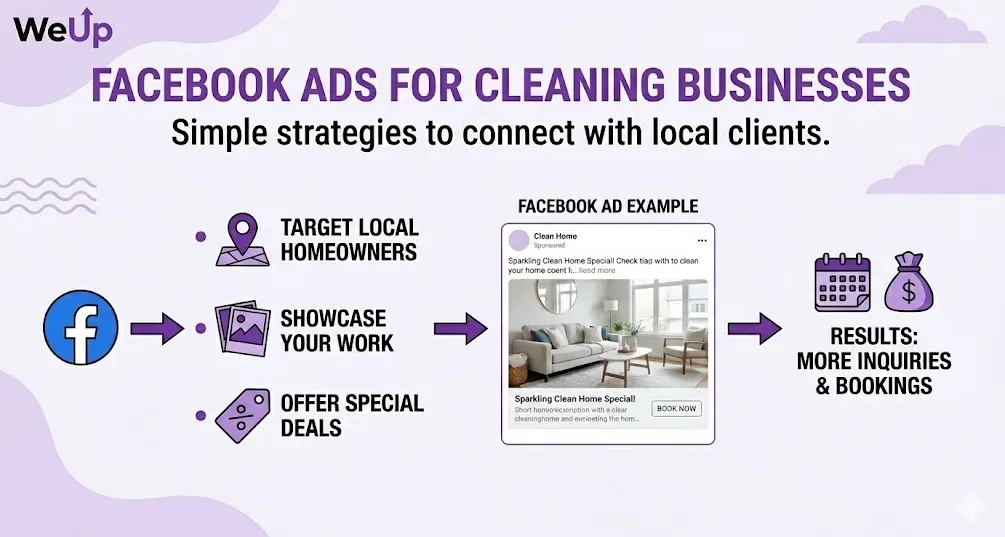
Facebook ads cleaning businesses, work best when they are used to introduce your service to local homeowners in a simple and approachable way. They are effective at offering an easy path to request a quote or check availability. They also help fill open spots on your schedule by putting your service in front of people who may not be actively searching yet.
Because attention is limited, ads perform better when they focus on one clear service. Trying to promote every type of cleaning at once often overwhelms the viewer and reduces responses. Ads that highlight a single service and a single next step consistently outperform ads that attempt to explain everything a company offers.
When cleaners align their expectations with what Facebook ads are meant to do, results tend to feel more predictable and less frustrating.
Why many cleaners struggle with Facebook ads
Most failed Facebook ad attempts come from a few predictable mistakes. These issues are common, especially for beginners, and they usually have nothing to do with the quality of the cleaning service itself.
One of the biggest mistakes is boosting posts. Boosting feels simple, but it gives Facebook full control over who sees your ad. You lose targeting clarity, tracking, and optimization. This often leads to low quality leads and no clear understanding of what worked or what failed.
Another common issue is treating an ad like a regular social media post. Many cleaners run ads that are just a flyer, a logo, or a picture of their business name. An ad is not the same as a post. A post is designed for people who already follow you. An ad is shown to strangers. It needs to quickly explain the service, the benefit, and the next step. Logos and flyers rarely do that, so they tend to get ignored.
Slow response time is another major problem. A homeowner who fills out a form or sends a message expects a fast reply. When hours pass without a response, they move on to someone else. In practice, we see response rates increase by at least five times when leads are contacted immediately.
The final issue is giving up too early. Facebook ads do not always produce results in the first day or two, especially for new advertisers. Shutting them off too soon prevents the system from learning and optimizing. What feels like failure is often just the learning phase.
What beginners should expect in the first one to two weeks
The first two weeks of running Facebook ads are often the most confusing for beginners.
If you are running ads for the first time, your ad account will likely have spending limits. It is common to see daily caps as low as two dollars. Facebook does this to test trust and payment reliability. Over time, these limits increase naturally.
Billing issues are also common early on. Facebook may run several small charges to verify your card. Some banks flag this as suspicious activity, which can pause ads unexpectedly. This is frustrating, but normal.
During this period, results can be inconsistent. Cost per lead may fluctuate. Some days may be quiet. This does not mean the ads are failing. It means the system is still learning.
What a good cleaning ad actually looks like

High performing Facebook ads for cleaning businesses are simple, clear, and easy to understand within a few seconds. Most people scrolling Facebook are not studying ads. They glance at them. If the message is not obvious right away, they keep scrolling.
Good cleaning ads do not rely on clever wording, fancy design, or complicated offers. They focus on clarity. The viewer should immediately understand what service is being offered, who it is for, and what to do next.
In practice, the ads that perform best usually share a few core traits.
They use a clean image or a short video that feels real. This might be a before and after photo of a kitchen or bathroom, a short clip of a team cleaning, or a simple shot of a finished space. The content does not need to be polished. It needs to feel familiar and trustworthy to a homeowner.
They use clear, direct language that explains the service. Phrases like house cleaning, deep cleaning, move out cleaning, or recurring cleaning work better than vague brand statements. The goal is to remove confusion, not to sound impressive.
They include one obvious call to action. This might be “Get a quote,” “Request a cleaning,” or “Message us to check availability.” Multiple calls to action in one ad often reduce results because they force the viewer to think instead of act.
Before and after photos work well because they show transformation without explanation. Short videos also perform well because they feel more personal and help stop the scroll. Both formats work when the message stays simple.
What matters most is that the ad answers three questions quickly:
What service is this
Is this for someone like me
What do I do next
Ads that try to explain every service, every price, or every detail often confuse people. Overly detailed ads slow decision making and reduce responses. A good cleaning ad does not try to close the sale. It starts a conversation and makes the next step feel easy.
Budget expectations for beginners
Budget is one of the most misunderstood parts of Facebook ads for cleaning businesses. Many beginners either spend too little and get frustrated, or spend too much too quickly without understanding what they are paying for.
For most beginners, starting small but not too small is important. A daily budget between ten and twenty dollars is a reasonable range. Starting around fifteen dollars per day tends to work well because it gives Facebook enough activity to collect data while still keeping risk low.
When budgets are set too low, results often feel inconsistent. Ads may run for only part of the day or fail to reach enough people to generate meaningful feedback. Facebook’s system needs a certain amount of activity to learn who is most likely to respond. Without that activity, performance can feel random.
It is also important to understand that new ad accounts often have spending limits at first. Facebook may restrict how much you can spend per day while it evaluates payment history and account behavior. This can make early results slower, even if the ads themselves are set up correctly.
Once ads begin generating leads consistently, increasing the budget becomes easier and more predictable. Small increases allow Facebook to expand reach without disrupting performance. Scaling works best when it is gradual and based on real results, not guesswork.
For beginners, the goal of the first budget is not perfection. It is learning. A reasonable starting budget creates space for Facebook to optimize and for you to understand how ads fit into your business without unnecessary stress.
Why follow up matters more than the ad itself
Facebook ads for cleaning businesses are designed to start conversations, not finish them. The ad creates interest, but follow up determines whether that interest turns into a booked cleaning job. This is where many cleaning businesses see the biggest difference in results.
Fast follow up changes outcomes dramatically. When a lead is contacted immediately, response rates increase several times over. Homeowners usually request quotes from more than one cleaner. The business that responds first often sets the tone and wins the conversation. When follow up is delayed by hours or even a full day, the opportunity is usually gone.
Good follow up does not need to be complicated. A short message acknowledging the request and asking one clear question is often enough to keep the conversation moving. The goal of the first message is not to sell. It is to confirm interest and open communication. Calls can follow once the homeowner is engaged.
Consistency also matters. Missed leads rarely come back on their own. This is why many cleaners rely on some level of automation to ensure every lead gets an immediate response, even during busy workdays. Automation does not replace personal communication. It simply makes sure the conversation actually starts.
In practice, the difference between successful and unsuccessful Facebook ads often comes down to follow up. Two businesses can run the same ad with the same budget. The one that responds quickly and consistently will almost always book more jobs.
How to read these Facebook ad results and what they are actually worth

At first glance, Facebook ad dashboards can feel confusing. Numbers are shown, but without context it is hard to know whether the results are good or bad. This example is a strong reference point for a cleaning business, especially for beginners.
In this campaign, the ads generated 64 leads. That means 64 people actively raised their hand and requested more information or a quote. These are not views or clicks. These are real inquiries.
Those leads came from a reach of 7,144 people and 17,124 impressions. Reach shows how many unique people saw the ad. Impressions show how many total times the ad was displayed. Seeing an ad more than once is normal and often helpful for recognition.
The most important number here is cost per result, which is $6.69 per lead.
What a $6.69 lead means for a cleaning business
To understand the real value, it helps to think beyond the ad platform and look at what happens after the lead comes in.
Let’s walk through a realistic example.
If even 20 to 30 percent of these leads turn into booked jobs, that would mean roughly 13 to 19 jobs from this campaign.
If the average job value is:
$150 for a one time clean
Or higher for a deep clean or recurring setup
That puts revenue potential in the thousands of dollars, from a relatively small ad spend.
Even at the low end, a single booked job often covers the cost of multiple leads. Everything after that becomes profit or long term value, especially if a one time client turns into recurring service.
Why lead cost matters more than clicks or views
Many cleaners focus on impressions or reach, but those numbers do not pay the bills. What matters is how much it costs to start real conversations with homeowners.
A lead cost under ten dollars is generally very workable for cleaning businesses, assuming follow up is handled well. When response is fast and capacity exists, leads at this price point give businesses room to book jobs profitably.
This is also where follow up becomes critical. Two businesses could generate the same 64 leads at the same cost. The one that responds immediately and consistently will turn far more of those leads into revenue.
The bigger takeaway
Results like this show what Facebook ads for cleaning businesses are capable of when expectations are realistic and systems are in place. The ads are not closing the sale on their own. They are opening doors at a predictable cost.
When cleaners understand how to read these numbers and connect them to real booking potential, Facebook ads stop feeling like a gamble and start feeling like a measurable growth tool.
A real example of patience paying off
It is very common for cleaners to feel discouraged after the first few days of running Facebook ads. When leads do not come in immediately, it is easy to assume something is wrong and shut everything off.
In one case, a cleaner reached out after three days and said the ads were not working. They had spent a small amount, seen little activity, and were ready to stop the campaign entirely. Nothing was technically broken. The ads were simply still in the early learning phase.
They decided to stay patient and keep the ads live instead of restarting or turning them off.
The following day, they received three leads within a short period of time.
This pattern happens more often than people expect. Facebook ads need time to gather data, test placements, and identify which users are most likely to respond. Early performance can be uneven, especially for new ad accounts.
Turning ads off too early resets this process and delays results. Patience allows the system to stabilize and gives the ads a real chance to perform. For beginners, understanding this learning period can prevent unnecessary frustration and wasted effort.
How Facebook ads fit into a larger growth system
Facebook ads for cleaning businesses work best when they are part of a simple growth system, not when they are used on their own. Ads can bring attention quickly, but what happens after someone sees the ad determines whether that attention turns into real business.
Google reviews should be in place at the same time as Facebook ads, or ideally before ads begin. Many homeowners who see an ad will search the business name before responding. They want reassurance that the company is real and trustworthy. Recent, authentic reviews help remove hesitation and make it easier for someone to reach out.
Your website plays a similar role. It does not need to be complex or heavily designed. It needs to answer a few basic questions clearly and quickly. A good beginner website should make it obvious:
What services you offer
Where you operate
How to take the next step
When these elements are clear, ads have somewhere effective to send traffic. Without them, even good ads can struggle.
Everything else can wait. Search engine optimization is valuable over the long term, but it is usually not the fastest path for beginners who need leads now. Facebook ads paired with reviews and a clear website create a foundation that can support growth while other strategies are added later.
When Facebook ads are not the right move yet
Facebook ads are not helpful if you cannot handle the demand they create.
If you cannot respond quickly to messages or calls, leads will be wasted. If your schedule is already full and you cannot book new appointments, ads will only create stress.
In these cases, it is better to fix capacity and follow up first, then turn on ads.
Keeping Facebook ads simple as a beginner
Many cleaners struggle with Facebook ads because the setup feels overwhelming. The platform was not designed specifically for small service businesses.
Using simple, proven structures removes much of the guesswork. Clear offers, simple targeting, and consistent follow up matter more than advanced tactics.
Beginners do not need to master Facebook ads. They need a system that works consistently.
Final thoughts
Facebook ads for cleaning businesses can be one of the most reliable ways to generate new leads when used correctly. They are not instant, and they are not magic, but they are effective.
When expectations are realistic, budgets are reasonable, follow up is fast, and patience is applied, Facebook ads can become a dependable part of a cleaning business growth strategy.
The cleaners who succeed with Facebook ads are rarely the ones with the most creative ads. They are the ones who do the basics well and give the system time to work.