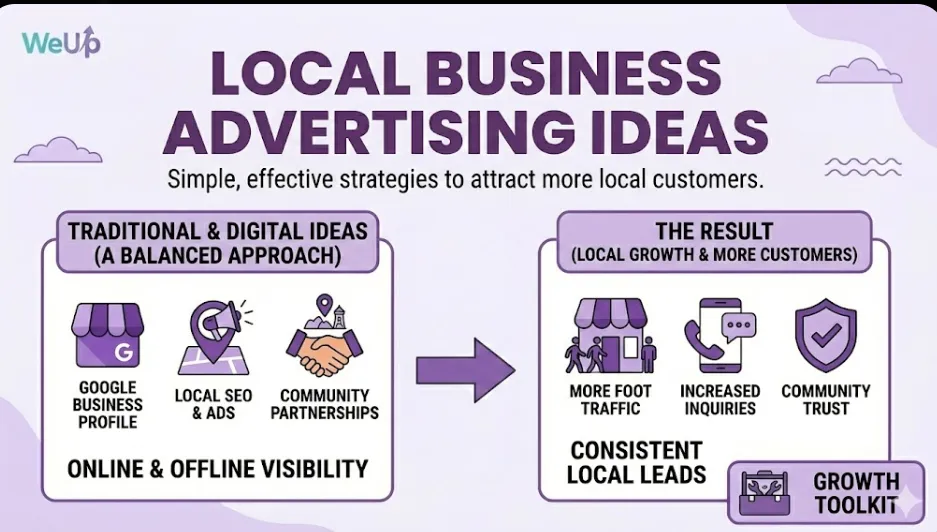
Local Business Advertising Ideas
Local business advertising looks very different for home service businesses than it does for big brands.
If you run a cleaning company, window washing business, pressure washing service, or landscaping company, you do not need complex funnels or expensive agencies to get results. You need visibility in your local area, trust from homeowners, and a way to respond quickly when someone shows interest.
This guide focuses on local business advertising ideas that actually work in real life, especially for home service businesses. These are ideas that help you get calls, texts, and bookings without wasting money or overcomplicating things.
Some of these strategies are free. Some cost a small amount of money. All of them are practical and based on what consistently works for local service businesses, not theory.
The goal is simple. Help people in your area find you, trust you, and book you. These local business advertising ideas are built specifically for service businesses trying to grow in their own neighborhoods.
Who This Guide Is For
This guide is for owners and operators of local home service businesses who want more consistent work without wasting money on marketing that does not translate into real jobs.
It is especially helpful for:
Residential cleaning companies
Window washing businesses
Pressure washing services
Landscaping companies
Solo operators and small teams trying to grow locally
You do not need a large budget, a marketing degree, or complicated software to benefit from these ideas. The focus is on simple actions that increase visibility, build trust, and turn interest into booked work.
How Local Business Advertising Is Different From Big Brand Advertising
Big brands advertise for awareness.
Local service businesses advertise for action.
A national company might run ads just to stay top of mind. A local cleaner or landscaper usually needs the phone to ring or the inbox to fill. That changes everything about how advertising should be approached.
Local advertising works best when it focuses on:
Trust and credibility over flashy design
Reviews and referrals over impressions and clicks
Speed of response over perfect branding
Neighborhood visibility over wide reach
A homeowner is not choosing between dozens of national brands. They are choosing between a few nearby options that seem reliable. The businesses that show up often, respond quickly, and have strong reviews usually win.
Free Local Business Advertising Ideas
Free advertising is often treated like a backup plan, but for many home service businesses it should be the starting point. These local business advertising ideas often outperform paid ads when done consistently, the tradeoff is your time. Before spending money on ads, it makes sense to build visibility and trust using methods that cost nothing except time and consistency. These strategies work because local services grow through reputation, referrals, and neighborhood familiarity more than flashy branding.
Ask Every Happy Client for Google Reviews
Google reviews are one of the strongest forms of free advertising available to local businesses. They affect how often you appear in search results and whether a homeowner feels comfortable contacting you. A company with dozens of recent five star reviews will usually receive more calls than a company with only a handful, even if the second business spends money on ads.
The key is consistency, not perfection. After completing a job that went well, send a short message thanking the client and include a direct review link. Do this every time, not just when you remember. Over a few months, the difference becomes dramatic. Businesses often double or triple their review count simply by asking politely and making the process easy.
Post in Neighborhood Facebook Groups
Neighborhood Facebook groups can generate real leads when used correctly. The mistake many owners make is treating these groups like a billboard instead of a community. Constantly posting promotions usually leads to being ignored or removed.
A better approach is to participate naturally. Answer questions, share small tips, and engage like a local resident rather than a marketer. When someone asks for a recommendation, that is when visibility turns into opportunity. People trust suggestions inside these groups because they feel personal and local, not like traditional advertising.
Have Clients Recommend You in Local Chats and Groups
Happy clients often belong to neighborhood chats, school groups, and community threads that you will never see directly. A single recommendation inside one of these spaces can lead to multiple new jobs. The problem is most business owners never think to ask for this type of visibility.
After a successful job, it is reasonable to say something simple such as, “If anyone in your neighborhood group is looking for this service, I would appreciate a mention.” This does not feel pushy when the work was done well. It turns satisfied customers into quiet promoters who introduce your name into conversations you would otherwise miss.
Use Referrals as an Advertising Channel
Referrals are not just luck. They can be treated like a repeatable advertising channel. Many home service businesses grow almost entirely through word of mouth because trust transfers faster than any ad can build it.
You can encourage referrals without offering large discounts or complicated programs. A short thank you message after each job, a reminder that you are open to new work, or a small incentive like a future service credit can keep your business top of mind. Even without incentives, simply doing high quality work and politely reminding clients that referrals help your business can create steady momentum. Over time, referrals often become the most reliable and lowest cost source of new jobs.
Low Cost Paid Local Business Advertising Ideas
Once the free local business advertising ideas are in place, paid options become more predictable. Paid advertising does not have to mean large budgets or risky spending. For home service businesses, the goal is not to reach everyone. The goal is to reach the right homeowners in the right area at the right time. When done with control and clear expectations, paid ads can become predictable instead of stressful.
The biggest difference between successful paid advertising and wasted spend is structure. Owners who set daily limits, target specific neighborhoods, and follow up quickly tend to see results. Owners who spend without a plan often assume ads “do not work” when the real issue is setup or follow through.
Running Facebook Ads the Right Way
Facebook ads remain one of the most accessible paid advertising channels for local service businesses because they allow tight geographic targeting and flexible budgets. You can choose exactly which cities or zip codes see your ads and adjust spending at any time.
The most effective ads for cleaners, window washers, pressure washers, and landscapers are simple. A clear photo, a short message, and a direct call to action outperform long explanations. Homeowners usually want to know three things: what you do, where you serve, and how to contact you. Complicated designs rarely improve results.
Equally important is what happens after someone clicks or sends a message. Fast responses and multiple follow ups often matter more than the ad itself. A great ad loses value if replies sit unanswered for hours.
Why Boosted Posts Do Not Work
Boosted posts feel easy, which is why many business owners try them first. The problem is that boosting a post removes most of the targeting and optimization controls that make ads effective. You are essentially paying to show a social media post to more people rather than running a true advertisement built for conversions.
Boosted posts usually lead to likes and views instead of calls and bookings. They can create the illusion of activity without producing measurable business results. Running proper ads through the ad manager gives far more control over location, audience, and objectives, which is why structured ads consistently outperform boosts.
What a Small Budget Looks Like in Practice
A realistic starting point for many home service businesses is around ten dollars per day. This comes out to roughly three hundred dollars per month. At this level, you are not trying to dominate the market. You are testing, learning, and building momentum.
With proper targeting and quick follow up, even small budgets can produce leads at reasonable costs. The key is consistency. Turning ads on for a few days and then stopping rarely gives clear data. Running them steadily for several weeks provides enough information to see what works and make improvements.
When Google Local Service Ads Make Sense
Google Local Service Ads can be powerful, but they are not ideal for every stage of a business. These ads often cost more per lead than social platforms, which means they work best for companies that already have strong reviews and an established reputation.
A practical benchmark is having a solid base of five star reviews before investing heavily. When homeowners see high ratings attached to your name, the higher cost per lead can still produce profitable jobs. Without that trust built in, the same spend may not convert as well.
For many home service businesses, social ads and review growth come first. Local Service Ads tend to perform better once credibility is already visible and consistent.
The Role of a Simple Website in Local Advertising
A website for a home service business is less about design and more about credibility. Many owners delay building one because they think it needs to be complex or expensive. In reality, a simple site often performs better than an overbuilt one because it focuses on clarity instead of distraction.
When someone hears your name from a referral, sees your comment in a neighborhood group, or clicks on an ad, they often search for your business before contacting you. If nothing shows up, trust drops. A basic website acts like a digital business card that confirms you are real, local, and reachable. It does not need advanced features to do this job well. It just needs the right information in the right place.
What Your Website Actually Needs
A strong local service website is simple and direct. The goal is to answer the main questions a homeowner has within a few seconds. Most visitors are not looking to read long paragraphs. They want confirmation and a clear way to reach you.
At minimum, your site should include:
Services you offer written in plain language
Cities or neighborhoods you serve
A phone number and contact form that are easy to find
A few real photos of your work or team
Reviews or short testimonials
Clear headings so people can scan quickly
This structure builds trust and reduces hesitation. When visitors can immediately see what you do, where you work, and how to contact you, they are more likely to reach out. Even a one page website can accomplish this if it is organized well.
What Your Website Does Not Need
Many home service businesses overspend on features that do not increase bookings. Fancy animations, complex booking systems, and large blocks of text often add cost without improving results. Homeowners rarely choose a cleaner or landscaper because of special effects on a website.
You usually do not need:
Multiple pages filled with repetitive content
Custom graphics or expensive branding packages
Advanced scheduling tools at the start
Long mission statements or company history sections
Perfect design before launching
A simple, functional site that loads quickly and answers basic questions will outperform a beautiful but confusing one. The priority is trust and accessibility, not perfection. As the business grows, the website can grow with it, but in the beginning simplicity is an advantage rather than a limitation.
Why Speed to Lead Matters More Than the Ad Itself
Many home service owners spend hours thinking about ad images, wording, and budgets but only minutes thinking about response time. In practice, response time often determines whether an ad succeeds or fails. You can run a strong advertisement and still lose the job if you wait too long to reply.
When a homeowner reaches out, they are usually contacting more than one company. The first business that responds clearly and professionally has a major advantage. Speed builds confidence. Delays create doubt. Even a difference of thirty minutes can change who gets the booking.
Advertising creates interest. Speed to lead turns that interest into revenue.
What Speed to Lead Means in Real Life
Speed to lead simply means how quickly you respond after someone calls, texts, fills out a form, or sends a message. It is not just about being fast once. It is about having a habit of responding quickly every time.
In real life this can look like:
Replying to messages within a few minutes when possible
Returning missed calls the same day
Sending a quick acknowledgment even if you need more time to give a full quote
Having simple scripts ready so you are not typing from scratch each time
You do not have to be available every second of the day, but long silent gaps reduce trust. Even a short message like “Thanks for reaching out, I will send you details shortly” keeps the conversation alive and shows professionalism.
Why One Follow Up Is Not Enough
Many potential clients do not respond right away, and that does not always mean they are not interested. People get busy, forget, or open messages at inconvenient times. If you only reach out once and stop, you often lose opportunities that were still open.
Following up a few times, spaced respectfully, can make a large difference. A second or third message is usually not seen as pushy when it is polite and helpful. It signals reliability rather than desperation.
Consistent follow up also separates organized businesses from casual ones. Homeowners often choose the company that stays engaged and communicates clearly. A great ad might get attention, but steady follow up is what turns attention into actual booked work.
How Reviews Impact Ad Costs and Lead Quality
Reviews influence far more than reputation. They directly affect how much you pay for leads and the type of clients you attract. Two businesses can run nearly identical ads, but the one with stronger reviews usually converts more clicks into real conversations. When homeowners see a high review count and positive feedback, hesitation drops and trust forms faster.
This creates a compounding effect. Better trust leads to higher response rates. Higher response rates lead to more bookings. More bookings lead to more reviews. Over time, this cycle reduces wasted ad spend and increases the quality of inquiries coming in.
Why Reviews Lower Advertising Costs
Advertising platforms reward businesses that convert attention into action. When more people click your ad and then contact you, the platform sees your ad as relevant. Relevance often leads to lower costs per click or lower costs per lead because the system wants to show ads that users respond to.
Reviews help this process in a practical way. A homeowner who sees fifty strong reviews is more likely to click and message than someone who sees five mixed ones. That higher engagement rate improves ad performance without increasing your budget. In simple terms, strong reviews make every advertising dollar work harder.
There is also a psychological factor. When people trust what they see, they need less convincing. You spend less money trying to overcome doubt and more money converting already interested prospects.
How Reviews Attract Better Jobs
Reviews do not just increase the number of leads. They often improve the quality of those leads. Homeowners who read positive feedback usually come in with clearer expectations and greater confidence. This leads to smoother conversations and fewer price shoppers.
Higher review counts also signal professionalism and consistency. Clients looking for reliable long term services, recurring cleanings, or larger projects tend to prioritize businesses with visible proof of quality. Instead of attracting only one time bargain seekers, you begin attracting clients who value reliability and are willing to pay fair rates.
In this way, reviews shape both visibility and client behavior. They filter who contacts you, not just how many people do.
Real World Advertising Results From Local Service Businesses
Advertising advice is everywhere, but numbers from real service businesses are what help owners set realistic expectations. Local advertising rarely produces overnight success, yet consistent effort often leads to steady, measurable growth. When ads are paired with strong reviews and quick follow up, the results become much more predictable.
These examples are not guarantees or promises. They simply show what has been possible when basic principles are followed correctly. The biggest takeaway is not the exact numbers. It is the pattern. Consistency, trust, and response speed usually matter more than large budgets.
Facebook Ads Cost Per Lead Examples
Facebook ads can vary widely in cost depending on location, competition, and follow up speed. However, local home service businesses often see affordable lead costs when targeting specific neighborhoods and running simple, clear ads.
Real examples from service businesses have included:
Leads as low as $3.38 per lead
93 leads at $5.49 per lead
162 leads at $4.47 per lead
These results came from straightforward ads focused on local areas rather than broad targeting. The ads were not overly complex. The difference was quick responses and steady follow up once someone showed interest. When businesses treated ads as part of a system instead of a one time experiment, lead costs stayed more manageable.
Google Review Growth Examples
Review growth often produces slower but longer lasting results than paid ads. Unlike ads, reviews continue to influence visibility even when spending stops. Service businesses that ask consistently after each successful job have seen major shifts in how often they appear in searches and how confident new clients feel reaching out.
Examples of review growth have included:
Doubling total review count within a few months
Increasing from around 10 reviews to 70 or more over a steady period
This kind of growth does not usually happen from a single request. It happens from building a habit of asking every satisfied client and making the process easy. As review counts rise, businesses often notice higher response rates on ads and more direct inquiries without additional spending.
Common Local Advertising Mistakes to Avoid
Many local service businesses do not fail because advertising “does not work.” They struggle because small mistakes compound over time and drain both money and motivation. Avoiding a few common traps can save months of frustration and thousands of dollars.
The goal of advertising is not activity. It is booked jobs. When effort is not tied to clear outcomes, it becomes easy to spend time and money without seeing real return. Even strong local business advertising ideas can fail when these mistakes happen.
Boosting Posts Instead of Running Ads
Boosting posts feels simple and fast, which is why many owners try it first. The issue is that boosted posts are designed for visibility, not conversions. They often generate likes, comments, and views instead of calls and messages.
Running structured ads through proper ad tools allows you to control location, audience, and objectives. You can choose specific cities, zip codes, or homeowner interests rather than hoping the right people see your post. Without this control, boosted posts usually create the appearance of momentum without producing measurable business results.
Paying for Expensive Marketing Before the Basics Are Right
Some businesses invest in high priced agencies or complex systems before they have strong reviews, a simple website, or consistent follow up habits. This often leads to disappointment because the foundation is missing.
Advertising works best when the basics are already in place. A business with clear contact information, recent reviews, and fast response times will almost always outperform a business with better graphics but weak fundamentals. Spending heavily before building trust and structure usually increases risk rather than results.
Advertising Without a Clear Goal
Advertising without a defined objective is one of the most common and costly mistakes. Posting or running ads just to “be active” makes it difficult to measure success. Without a goal, there is no way to know whether an effort is working or needs adjustment.
Clear goals might include a certain number of weekly leads, booked estimates, or new reviews gained each month. When advertising is tied to specific outcomes, decisions become easier. Budgets, targeting, and messaging can all be adjusted based on real data instead of guesswork.
What to Focus on in the Next 30 Days
Growth in local service businesses usually comes from doing a few fundamentals consistently rather than trying everything at once. The next thirty days should not be about mastering every marketing channel. It should be about building momentum in the areas that produce the highest return with the lowest risk.
This order keeps costs low while increasing trust and visibility at the same time. Each step strengthens the next, so when you do begin advertising, the results are more predictable and less stressful.
Reviews First
Start by making reviews a weekly habit. Every satisfied client is an opportunity to strengthen your online reputation. A higher review count improves how often you appear in local searches and increases confidence when someone checks your business before contacting you.
The focus is not on chasing perfect wording or long testimonials. It is about consistency. Send a simple message after each completed job with a direct link and a thank you. Even a few new reviews each week can create noticeable improvement within a month. This foundation makes every future marketing effort more effective.
Referrals Second
Once review requests become routine, shift attention to referrals. Referrals are one of the lowest cost and highest trust forms of advertising because they come from real experiences instead of promotions. Many business owners assume referrals will happen naturally, but a polite reminder often makes the difference.
After completing quality work, let clients know you are open to new jobs and appreciate recommendations. This can be a short message or a brief mention at the end of a conversation. Over time, referrals can create a steady flow of new clients without additional spending.
Then Advertising
Advertising works best when it is layered on top of strong reviews and active referrals. At this stage, even a small daily budget can produce better outcomes because trust and visibility are already in place. Without that foundation, ads often feel unpredictable and expensive.
Begin with simple, targeted campaigns focused on your local area rather than wide reach. Pair every ad with quick response times and multiple follow ups. Advertising should amplify what is already working, not compensate for what is missing.
Final Thoughts
Local business advertising ideas do not have to be complicated to be effective. Most home service businesses grow when they focus on visibility, trust, and response speed rather than chasing every new marketing tactic.
Start with the fundamentals. Build reviews consistently, encourage referrals, and make sure anyone who hears your name can quickly find clear information about your services. These actions cost little but create real momentum.
When you do move into paid advertising, keep it simple and controlled. Target your local area, respond quickly to every inquiry, and follow up more than once. Ads work best when they sit on top of strong reviews and steady word of mouth, not when they are expected to carry the entire business alone.
In the end, local advertising is less about flashy strategies and more about repeatable habits. Businesses that show up often, communicate clearly, and make it easy for happy clients to speak for them tend to win over time.